
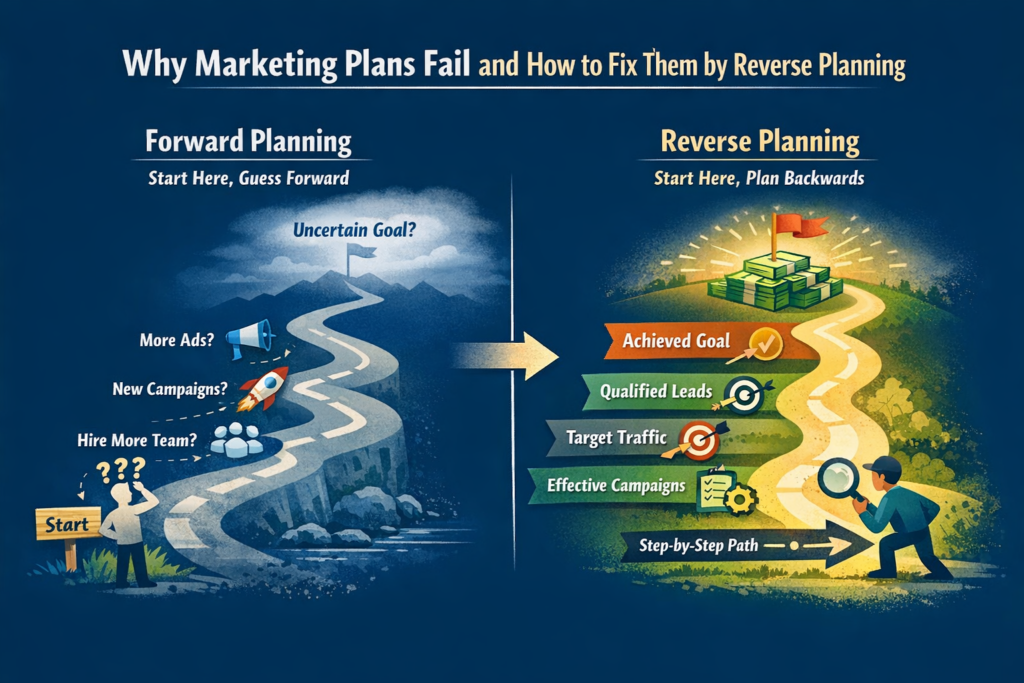
Marketing teams plan the same way: start with where you are today, then map out steps forward toward some future goal. Increase leads by 20%. Improve brand awareness. Launch three new campaigns this quarter.
The problem? This forward-thinking approach ignores something fundamental about how we make decisions: we hate uncertainty. And when plans are built step-by-step into an unclear future, every choice multiplies that uncertainty until the whole strategy feels like guesswork.
There’s a better way. It’s called reverse planning, and it flips the entire process.
The Planning Method That Feels Wrong But Works Better
Reverse planning starts at the end.
You begin with the goal already achieved, then work backward to figure out what steps made it happen.
Think of it like a detective reconstructing a crime scene. The outcome is known. The job is tracing back through the evidence to understand how you got there.
In marketing terms, this means starting with concrete revenue results, then reverse-engineering the activities, channels, budget allocation, and metrics that produced those results.
How We’re Wired to Think (And Why It Limits Us)
Our brains default to chronological thinking. It’s linear, it’s intuitive, and it worked fine for most of human history. Plan the next meal, the next hunt, the next harvest.
But modern business problems are more complex.
When you’re trying to grow revenue from $2M to $5M, linear thinking gives you a plan that looks like this:
- Run more ads
- Create more content
- Hire more people
- Hope it works
Each step introduces new variables and uncertainty. You’re constantly asking “what should we do next?” with incomplete information.
Reverse planning flips this. Instead of asking what to do next, you ask: “If we hit $5M in revenue, what marketing mix made that possible?”
Suddenly, you’re not guessing. You’re solving a puzzle where the picture is already visible.
The Research Behind Reverse Planning
A joint study by researchers in the United States tested this approach with students preparing for exams. One group planned their study schedule forward (traditional method). The other group started by imagining they’d already aced the exam, then worked backward to identify what study actions led to that success.
The reverse planning group performed better on the actual exam.
Why? Three key findings:
1. Goals felt more achievable
When you start at the finish line, the goal immediately feels closer and more concrete. It’s not some distant target you’re marching toward. It’s a reality you’re already standing in.
2. Steps became clearer
Students who planned backward reported having a clearer sequence of actions. They weren’t choosing from infinite possibilities. They were identifying the specific steps that connected their current state to the achieved goal.
3. Uncertainty decreased
Instead of facing countless decisions about what might work, they were essentially “filling in the blanks” between two known points. The mental load dropped significantly.
This isn’t just useful for students. It’s how smart marketers should approach strategy.
How Reverse Planning Works in Marketing
Let’s say your goal is to generate $500K in new marketing revenue over the next 12 months.
Traditional Forward Planning:
- Increase ad spend by 30%
- Launch email nurture campaigns
- Create more content for SEO
- Test new channels
- Improve conversion rates
This list is vague. It’s reactive. And it doesn’t connect to the revenue goal in any measurable way.
Reverse Planning:
Start at the end: $500K closed revenue
Now work backward:
Step 5 (End): $500K closed revenue
Step 4: To close $500K, we need 50 deals at $10K average. That requires 150 qualified sales conversations (33% close rate).
Step 3: To get 150 sales conversations, we need 600 marketing qualified leads (25% MQL-to-conversation rate).
Step 2: To generate 600 MQLs, we need 6,000 website visitors converting at 10%.
Step 1 (Now): Current traffic is 2,000/month. We need to triple it through paid ads, SEO content targeting high-intent keywords, and partnership referrals.
See the difference? Every number connects to the revenue outcome. You’re not guessing what might work. You’re identifying what must work to hit the goal.
This is how I build Growth Clarity plans. The entire strategy is reverse-engineered from revenue targets, not built forward from marketing activities.
The Second Type of Reverse Thinking: Inversion
There’s another powerful way to use reverse planning: flip the goal itself.
Instead of asking “How do I achieve success?”, ask “How would I guarantee failure?”
This technique, championed by investor Charlie Munger (Warren Buffett’s business partner), is called inversion. Munger famously said: “All I want to know is where I’m going to die, so I’ll never go there.”
Why Inversion Works
When you list everything that would tank your marketing results, you often discover you’re already doing some of those things without realizing it.
Example: How to Guarantee Your Marketing Fails
- Spread budget across too many channels with no focus
- Chase vanity metrics (impressions, followers) instead of revenue
- Run campaigns with no attribution or measurement
- Ignore customer acquisition cost until it’s too late
- Keep investing in channels because of sunk cost, not current performance
- Launch tactics without connecting them to business goals
Now flip it. Your marketing plan should systematically avoid these failure modes. Suddenly you have a checklist for quality control built into your strategy.
This is exactly what Growth Audit does. It identifies where budget is leaking, where attribution is lying to you, and which channels are draining resources without delivering returns. Then you can stop doing the things that guarantee failure.
Combining Forward and Reverse Planning
Neither approach should replace the other. The key is knowing when to use each.
Use reverse planning when:
- You need a clear path to specific revenue goals
- Budget allocation decisions are critical
- You’re justifying marketing spend to leadership
- Uncertainty is creating paralysis in your team
- You need to align marketing activity to business outcomes
Use traditional forward planning when:
- You’re testing new ideas or channels
- Flexibility and iteration are more important than precision
- You’re in early-stage exploration mode
- The market is changing too fast for rigid planning
Use inversion when:
- You’re diagnosing what’s broken in current strategy
- You want to pressure-test a plan for blind spots
- You need to cut waste before adding new initiatives
- You’re dealing with complex attribution and unclear ROI
Most effective marketing strategies combine all three. Start with reverse planning to anchor everything in revenue. Use inversion to identify and eliminate waste. Then use forward planning for tactical execution and optimization.
Why This Matters for Your Business
If your marketing feels like throwing budget at the wall to see what sticks, reverse planning gives you the structure to make every dollar accountable.
If you’re investing in channels because “everyone does it” or because you already spent too much to quit now, inversion helps you cut losses and reallocate to what actually works.
And if you’re stuck between strategy, execution, and endless optimization, having a planning methodology that connects all three makes the difference between marketing that looks busy and marketing that drives growth.
This is the foundation of how I work with clients:
Growth Clarity uses reverse planning to build strategies anchored in revenue logic. We start at your revenue goal and work backward to identify the exact marketing mix, budget allocation, and metrics that will get you there.
Growth Audit uses inversion to diagnose where your current spend is failing. We find the cost leaks, broken attribution, and sunk cost decisions that are bleeding your budget.
Growth Acceleration takes the reverse-engineered plan and executes it systematically, so insights carry forward quarter after quarter instead of getting lost in chaos.
Start With the End in Mind
Your brain wants to plan forward. It’s intuitive, it’s familiar, and it feels safe.
But safe isn’t always effective.
Reverse planning might feel unnatural at first. Starting at the finish line when you’re standing at the starting blocks goes against every instinct.
That discomfort is the point. It forces you to think differently, to question assumptions, and to connect every action to a measurable outcome.
The students who planned backward performed better. The detectives who work from the crime scene backward solve more cases. And the marketers who reverse-engineer their strategies from revenue targets deliver results that forward-thinking competitors can’t match.
So next time you’re building a marketing plan, try starting at the end. You might be surprised how much clearer the path becomes when you’re not guessing your way forward into the fog.
Ready for results-driven marketing?
Let's turn your strategy into repeatable, measurable growth through structured execution.