
Your revenue target is set. The pipeline isn't keeping up. The last agency sent tidy monthly reports and very little revenue, and a senior marketing hire feels like a big, slow bet you can't afford to get wrong. So the decision moves to next quarter, which is usually the quarter the target gets missed.
This article is for founders and CxOs of early to mid-stage B2B companies (think seed to Series A) who need senior marketing without another expensive experiment. You'll get a clear way to compare a full-time hire, an agency and a fractional growth lead, four fit checks to choose between them, and what months 1 to 3 should deliver if you go fractional.
Key takeaways
- The question isn't hire or outsource. It's who owns the revenue plan and the system that runs it.
- A fractional growth lead works embedded, 2 to 3 days a week, with your team and the stack you already have.
- Month 1 should produce a revenue-backwards plan and working tracking, not a brand deck.
- No revenue target, or a need for 40 hours of execution a week? Then it's the wrong model.
The real choice isn't hire or outsource. It's who owns the revenue plan.
Most founders frame this as a staffing question: bring marketing in-house, or buy it outside? That framing skips the part that actually breaks.
Somebody has to own the line from the revenue target to the work done every week. How many deals do we need? How many opportunities does that take, how many qualified leads, from which audiences, through which channels, at what cost? And somebody has to own the system that shows, every month, whether that line is holding.
When nobody owns it, you get activity: posts, campaigns, a newsletter, a new tool. Plenty of motion, no direction. When someone owns it, every piece of activity has a number it's supposed to move.
Ownership of the revenue plan matters more than the employment model. Full-time, agency or fractional is the second question, not the first.
Why the full-time hire and the agency both feel like the wrong bet
Two different problems, and both are real.
The full-time hire. A senior marketer is a full annual salary plus employer costs, before tools and budget. It's also a long-term commitment made before you know exactly what the role needs, and expensive to undo if the profile turns out to be wrong. Then there's time to impact: a search, interviews, a notice period and onboarding all come before anyone touches the revenue plan. For a company at seed or Series A, that's a lot of runway spent waiting.
The agency. Agencies are built to deliver a scope: a channel, a campaign, a retainer of hours. They optimise what they're paid to run. Paid social gets cheaper clicks, SEO gets more traffic. Nobody inside the agency is accountable for whether your pipeline reaches the target, because that was never in the contract. Hence the reports.
Both routes leave the same gap, at least for a while: nobody senior sits between the P&L and the channels, owning the numbers in both directions.
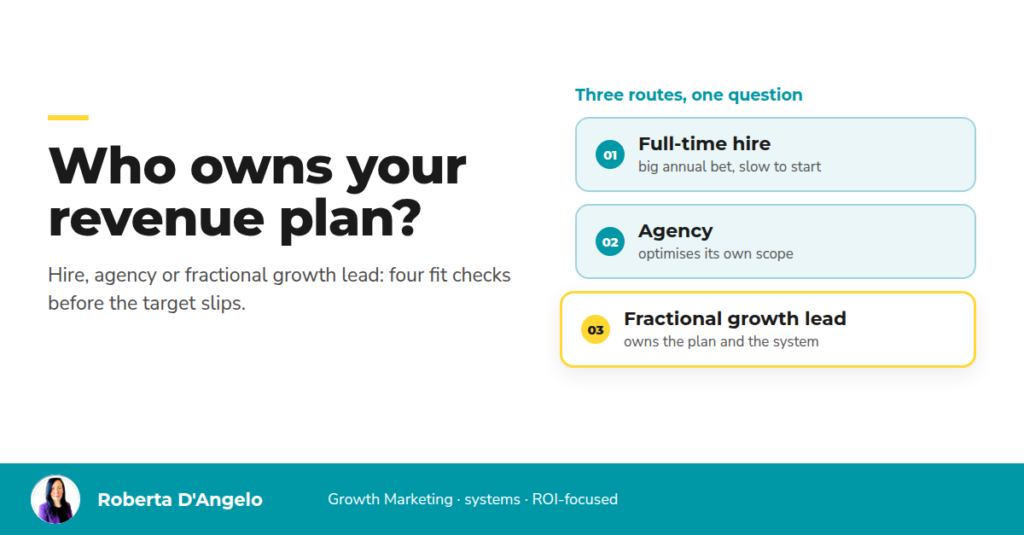
A hire is a big, slow bet. An agency is quick to start but owns only its scope. Neither gives you senior ownership of the target, fast.
What a fractional growth lead owns, and what they don't
A fractional growth lead is a senior growth marketer embedded in your company part-time, typically 2 to 3 days a week. They work inside your team, your tools and your numbers, occasionally on site, rather than reporting to you from the outside.
What they own:
- The revenue-backwards plan and its funnel numbers, per channel and in total, broken down by market and audience.
- The operating system that runs it: tracking, CRM pipeline stages, a monthly reporting rhythm.
- Priorities and budget recommendations: what to fund, what to stop, what to test next.
- Accountability to the numbers, in a monthly review with the leadership team.
What they don't own:
- Your sales process. They align marketing to it, they don't replace it.
- Every execution task. Volume work goes to your team, freelancers or automation.
- A favourite channel or tool. The plan decides the channels, not the other way round.
How is that different from a fractional CMO? In my experience, a fractional CMO sets direction and leads a team that executes. In a 10 to 50 person company there often isn't a team to lead yet. A fractional growth lead designs the plan and builds the system that runs it, hands-on. Strategy and execution stay in the same pair of hands, with senior judgement from the first week and without the annual commitment.
How it works: from the P&L target backwards, through one operating system
The work starts at the end. Take the revenue target and translate it backwards: revenue, deals, opportunities, qualified leads, leads, reach. Set those numbers per channel and in total, then break them down by market and audience where it sharpens a decision. Use your own conversion rates where they exist and conservative assumptions where they don't, and mark which is which, so nobody mistakes a guess for a fact.
That plan is only useful if it's connected to what happens every week. This is where I use what I call the marketing operating system (MOS): one layer that links four things that usually live in four different places.
- The P&L target and the marketing budget.
- The funnel numbers, per channel and in total.
- Tracking and the CRM pipeline that report against those numbers.
- The content and campaign plan that feeds the funnel.
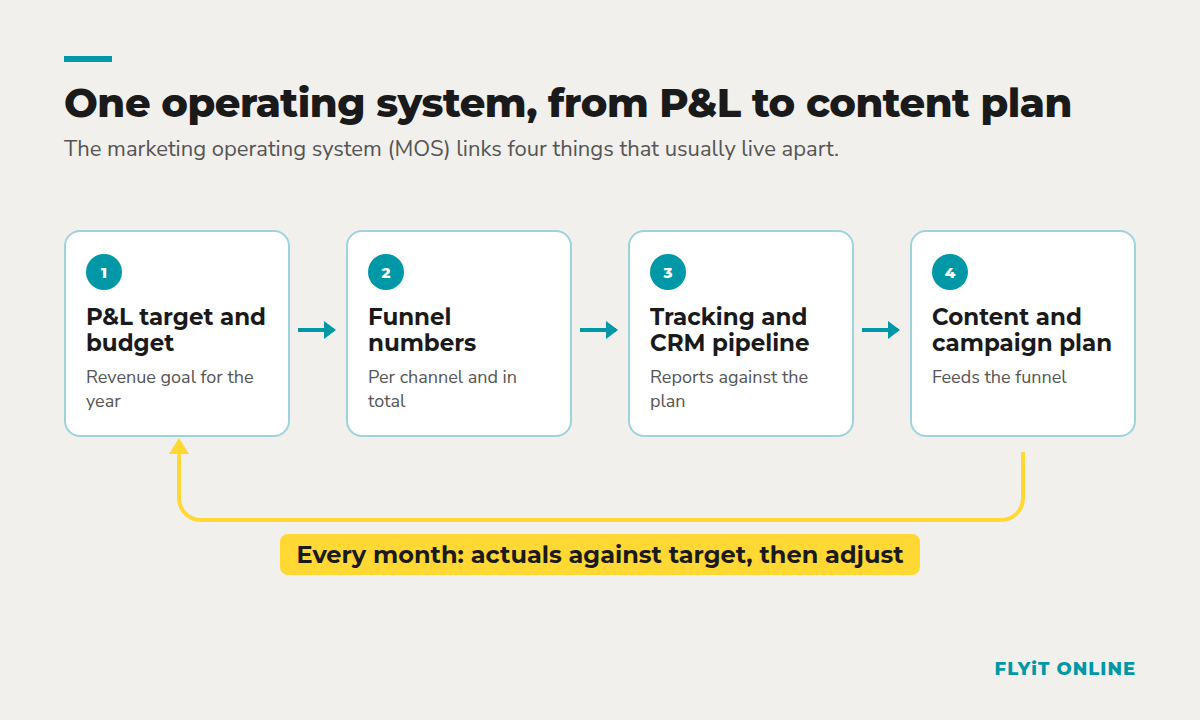
When the four are linked, a drop in qualified leads from one channel shows up as a gap against the target, not as a vague feeling that "LinkedIn isn't working". Each month you see which number moved and decide what to change across channels; day-to-day tuning, like paid media, stays inside the channel tools. It's tool and channel agnostic: it sits on the stack you already have, whether that's HubSpot, Pipedrive, Brevo or a well-kept spreadsheet. You can see the full approach on the Flyit Online growth services page.
The plan sets the numbers; the operating system tells you every month whether they're holding.
Months 1 to 3: what a fractional growth lead should deliver
If you go fractional, hold the engagement to deliverables, not hours. Here's what the first quarter should put in your hands.
Which numbers to watch in those 90 days? Treat these as the measurements a good plan tracks, not as promises:
- Early signals: share of new leads that match your ICP, lead to MQL conversion, cost per MQL by channel.
- Middle of the funnel: MQL to SQL conversion, time to first sales contact.
- Business outcomes: pipeline value created against plan, and the trend in customer acquisition cost. If you want the reasoning behind these, read the 3 revenue metrics every B2B marketer should track.
By the end of month 1 you should know which numbers matter. By month 3 you should be acting on them.
What this looked like at an AI-native creative studio expanding into Europe
A real example, anonymised. The company: an AI-native creative studio based in France, expanding into English-speaking European markets, with no in-house marketing team. I work with them embedded, as their fractional growth marketing director.
We built the go-to-market architecture from zero: funnel maths, a four-layer ICP, eight activation channels, an ROI model and localisation. Then the system to run it: AI content agents and n8n automations, a 33,000-contact CRM segmented by audience, and an operating system connecting targets to tracking and content.
What moved between Q1 and Q2 2026:
- MQLs up 8.7x quarter on quarter.
- Website traffic up 330%, with an English-language audience built from zero.
- 4% conversion from discovery to MQL.
- Around 65% less time spent on content production compared with doing it manually.
- 145% ROI on total marketing investment over H1 2026.
An honest caveat: big multiples partly reflect where you start, and the English-language audience here started at zero. The part that transfers to your company is the sequence. Plan first, tracking second, automation third: the numbers came after the system, not before.
Four fit checks: hire, agency or fractional growth lead?
If three of the four checks point to the right-hand column, a fractional growth lead is worth a serious conversation. And it isn't always either-or: if the role is permanent and you'll need a full week of ownership for years, hire. Going fractional first often makes that hire better, because by then you know what the role needs and the system it will run.
When a fractional growth lead is the wrong call
It isn't the answer for everyone. Skip it if:
- You don't have a revenue target yet, or the business model is still being tested. Start with a defined strategy piece such as Growth Clarity, not an embedded lead.
- You need a full-time execution machine (daily campaigns, events, high-volume content) and have no team or budget for freelancers. Two to three days a week won't cover it. Hire.
- You need one channel run well and already know it's the right one. A specialist agency is the simpler buy.
- Nobody in leadership has time to review the numbers monthly and decide. A fractional lead without a decision-maker turns into a very expensive report writer, which is the agency problem all over again.
Quick answers
What is a fractional growth lead?
A senior growth marketer embedded part-time, usually 2 to 3 days a week, who owns the revenue plan and builds and runs the system behind it, with your team and your tools.
How is a fractional growth lead different from a fractional CMO?
A fractional CMO typically sets direction and leads a team that executes. A fractional growth lead designs the plan and builds the operating system hands-on, which suits companies that don't have a marketing team to lead yet.
How quickly should a fractional growth lead show results?
The plan and tracking should be in place within the first one to two months. Pipeline results depend on your sales cycle, but a 90-day review should show early signals moving against the plan.
Do we have to change our marketing tools?
No. The work sits on your existing stack and only changes a tool where it blocks tracking or reporting.
Can one fractional lead cover several countries and languages?
Yes, if the plan segments by market and audience from the start and the content system is built to adapt messaging per market rather than translate it.
Next step
Growth Acceleration is how I work as an embedded growth lead: the revenue-backwards plan, the operating system, and the execution behind it, inside your team.
See how Growth Acceleration works
Roberta D'Angelo is the founder of Flyit Online. 15+ years in B2B growth marketing across 400+ businesses and 7 countries. She works embedded with B2B teams as a fractional growth lead, building the revenue plan and the system that runs it. About Roberta